From Draft NOtices, July‐September 2026
— Simeon Man
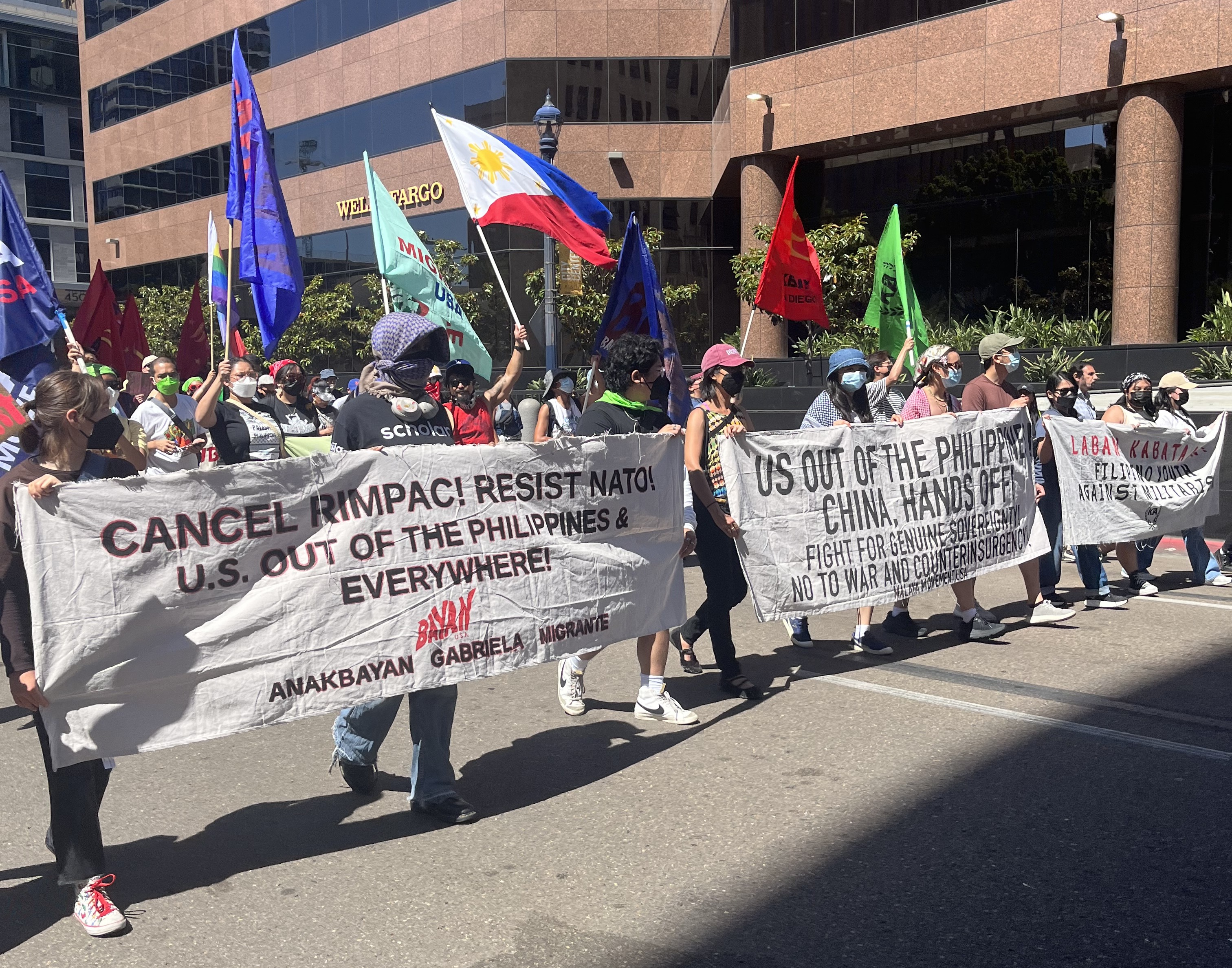
Military personnel from around the world have converged on the illegally occupied lands and waters of Hawai‘i this month (June 24-July 31) to participate in the Rim of the Pacific (RIMPAC), a biennial multinational maritime exercise led by the U.S. Third Fleet from Naval Base Point Loma in San Diego. From San Diego to Hawai‘i and throughout the Pacific, activists are mobilizing to stop the war drills, which are not “games” but an actual war on indigenous life and ocean life imperiling the planet.
The “world’s largest” and “premier maritime exercise,” RIMPAC has grown exponentially larger and more destructive since it began in 1971. This year’s 30th exercise involves 40 ships, 5 submarines, 140 aircraft, and 25,000 personnel from 31 countries engaging in weapons testing and live-fire demonstrations, amphibious raids, explosive ordnance disposal, and other activities designed to wreak havoc on the land and ocean. For example, according to OutWrite News Magazine, the sinking of decommissioned ships with live fire “triggers algal blooms [that] reduce[s] the oxygen in the ocean, stunt[s] coral reefs, and damage[s] marine biodiversity.” Acknowledging the deadly effects of the concentrated use of sonar and explosives on marine life, the U.S. Navy has worked out an agreement with the National Marine Fisheries Services to allow up to 26 million “takes,” each “take” referring to a marine mammal harassed, captured, or killed during military exercise.
RIMPAC escalates tensions with China while eroding people’s sovereignty in the Pacific region. According to NATO, such exercises aim to enhance “interoperability,” or the ability for allied forces “to operate together, to share common doctrine and procedures, along with each other’s infrastructure and bases.” It strengthens U.S. relationships with vassal states such as Japan and the Philippines, the countries that constitute what the Department of Defense calls “the first island chain” encircling China. In the name of interoperability, the U.S. has multiplied its warmaking capacity while making the people of this part of the world cannon fodder in its wars of aggression.
For RIMPAC 2026, Japan has taken a leading role as vice commander, consistent with its increasing militarization in recent years and the push by conservatives to revise Japan’s “pacifist” Constitution. Japan’s so-called Self-Defense Forces regularly participate in joint exercises with the U.S. and other forces, including, so far this year, Balikatan in the Philippines (April 20-May 8), Valiant Shield in Guam (June 22-July 1), and Resolute Dragon in Okinawa and the Ryukyu Islands (June 20-30). Activists are demanding an end to all war drills, not only RIMPAC, and to abrogate the U.S.-Japan Security Treaty, which has made Japan partner to U.S. imperialism and complicit in its war crimes – from the Korean War to the Vietnam War through today’s U.S.-Israel genocide in Gaza and war on Iran.
Although not part of the Pacific rim, Israel is participating in RIMPAC 2026, which makes sense given the unprecedented integration of the U.S. and Israel militaries recently cemented by the “United States-Israel Defense Technology Cooperation Initiative,” buried in the 2027 National Defense Authorization Act. RIMPAC’s showcase of interoperability is nothing less than a demonstration of how Israel’s settler colonial violence in Palestine is connected to Japan’s settler colonial violence in Okinawa, which in turn is connected to U.S. settler colonial violence in Hawai‘i and Turtle Island. Calls to Cancel RIMPAC must be framed by the larger demand to end all colonial occupation -- from Palestine to Okinawa to Guåhan to Hawai‘i.
In Hawai‘i, activists are growing the demand to “cease the lease,” as the U.S. Army seeks to retain its land holdings, including more than 22,000 acres of the Pōhakuloa Training Area that has been used for RIMPAC and other live fire training since the 1950s. These were lands stolen by the U.S. government in 1893 and leased by the state to the Army in 1964 for $1. With the leases set to expire in 2029, activists are fighting in the courts and in the streets to terminate them once and for all, achieve land back, and revitalize the sacred lands for future generations.
Forty-two years ago, activists in Hawai‘i campaigned to “Stop RIMPAC ’84, Protect Kaho‘olawe ‘Ohana.” They focused their campaign on protecting the island of Kaho‘olawe, which had been used by the Navy for bombing practice since the 1940s. Reading about this, I am reminded that although RIMPAC has long been around, so too have people’s struggles against colonialism and militarism, including the historic fights that led to the return of Kaho‘olawe in 1994. These struggles and victories shape our present conditions of possibility.
Follow @comdsd on Instagram for updates on this month’s actions by the Cancel RIMPAC Coalition in San Diego.
Information sources:
- [1] The Human Cost of RIMPAC and Calls to Resistance Ariana Castro, August 23, 2024 - OutWrite
- [2] Earth’s Greatest Enemy, film directed by Abby Martin, Empire Files, 2025.
- [3] Interoperability: connecting forces, Updated: 11 April 2023 - NATO.
- [4] Congress quietly moves to integrate US and Israeli militaries, Ben Freeman, May 29, 2026 - Responsible Statecraft.
This article is from Draft NOtices, the newsletter of the Committee Opposed to Militarism and the Draft (https://www.comdsd.org/).