From Draft NOtices, January—March 2009
—– Kathy Gilberd
On July 19, 2005, Private First Class LaVena Johnson’s battered and partially burned body was found in a military contractor’s tent in Baled, Iraq. She had a gunshot wound to the head, a broken nose and loose teeth, bruises and abrasions all over her body. A corrosive chemical had been poured over her genital area.
The Army ruled her death a suicide. Its investigation found “massive self-inflicted trauma,” and concluded that she had shot herself through the mouth with a rifle, crawled from her own tent to the contractor’s, and set it on fire in an attempt to hide her self-mutilation and suicide. Ms. Johnson’s family believes that the evidence shows she was raped and murdered by a fellow soldier. Their belief is supported by photographs and autopsy information they forced the Army to release under the Freedom of Information Act. It is also consistent with statements from those who had talked with her before her death – including her company commander, who described her as “clearly happy.”
LaVena Johnson’s case points to a frightening pattern of rape and other violence against women in the military. In March 2008, the Department of Defense’s (DoD’s) Sexual Assault Prevention and Response (SAPR) office admitted that there had been 2,688 reported cases of sexual assault in the military in 2007. At the time of the report, only 600 of those had resulted in any punishment or administrative action for the attacker. Not long after these figures were released, the Government Accountability Office (GAO) testified before a congressional subcommittee that the majority of sexual assaults in the military went unreported. Their findings matched a DoD survey conducted in 2006, which also found that at least half of those assaulted did not inform the military of the attacks.

Committee Opposed to Militarism and the Draft (COMD)
From Draft NOtices, October—December 2008
— Jorge Mariscal
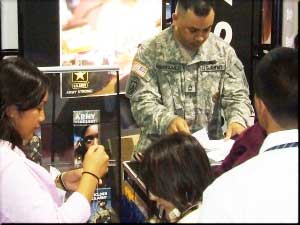 Strolling across the convention center with her granddaughter, Dolores Huerta, whomade history with Cesar Chavez more than 40 years ago, received an occasional greeting from those who recognized her. But most of the well-dressed Latino and Latina 20- and 30-somethings hurried past her on their way to free salsa lessons sponsored by Ford or free beer provided by Miller Lite.
Like the dozens of recently arrived immigrants and long-time permanent residents on their way to the free workshops on citizenship, they had no idea that they had just rubbed elbows with one of the major figures of U.S. labor and civil rights history.
If Barack Obama symbolizes “post-civil rights” politics, the National Council of La Raza (NCLR) conference held in San Diego in mid-July embodied a post-Chicano Movement universe in which unions, mass mobilizations, and social critique are relics of a long-gone era.
The NCLR Expo was a corporate-funded orgy of mainstream Hispanic identity and culture. Outside the convention center, misguided Minutemen and others angry about the immigration mess clung to the deluded belief that NCLR was a “leftist” or “separatist” organization. Inside the building, representatives of every branch of the military, the CIA, and the Department of Homeland Security belied the right-wing paranoia.
From Draft NOtices, October—December 2008
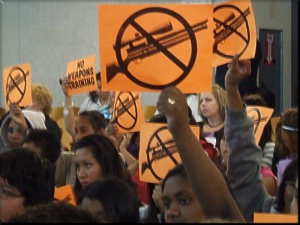 As reported in the July-September Draft NOtices, the San Diego Unified School District announced in May that it was investigating complaints voiced by students who had been involuntarily placed in military science courses (i.e., JROTC), a violation of the California Education Code. There were also complaints about students being recruited into the program with false promises that it would help them meet college entrance requirements. There are 13 secondary schools in the district with JROTC.
After waiting all summer and hearing no report on the investigation, a small group from the Education Not Arms Coalition attended the September 9 San Diego school board meeting and asked for a report on the investigation. School board members refused to comment, but district superintendent Terry Grier said that a report could be obtained from one of the area superintendents, Nellie Meyer.
The next day, Meyer contacted a coalition representative and stated that she interviewed some of the students who had complained and had found their accounts credible. Consequently, a directive was presented to principals at their monthly meeting, advising them to ensure that students were not placed into JROTC without first gaining parental consent. She said the directive would be presented at a second principals’ meeting and that we could request a copy of the directive from the district’s legal office.

Ninth CIRCUIT COURT RULING: CONFRONTING MILITARISM BY USING EQUAL ACCESS TO HIGH SCHOOLS

When the military comes to your local high school, you have a legal right to give students an opposing view. This has been the position taken by federal district courts in Florida, Pennsylvania and Illinois and two federal appellate courts. The most broadly-worded decision came from a case that COMD took to the Ninth Circuit Court of Appeals in the 1980s. Here is the background: